01
How to search Claude Code and Codex conversation history
Start with the project, prompt, or one phrase you remember; search the layer that can actually contain it.
Clear, source-checked writing about operating Claude Code, Codex, and agent Crews—where the mechanics, limits, and failure states stay visible.
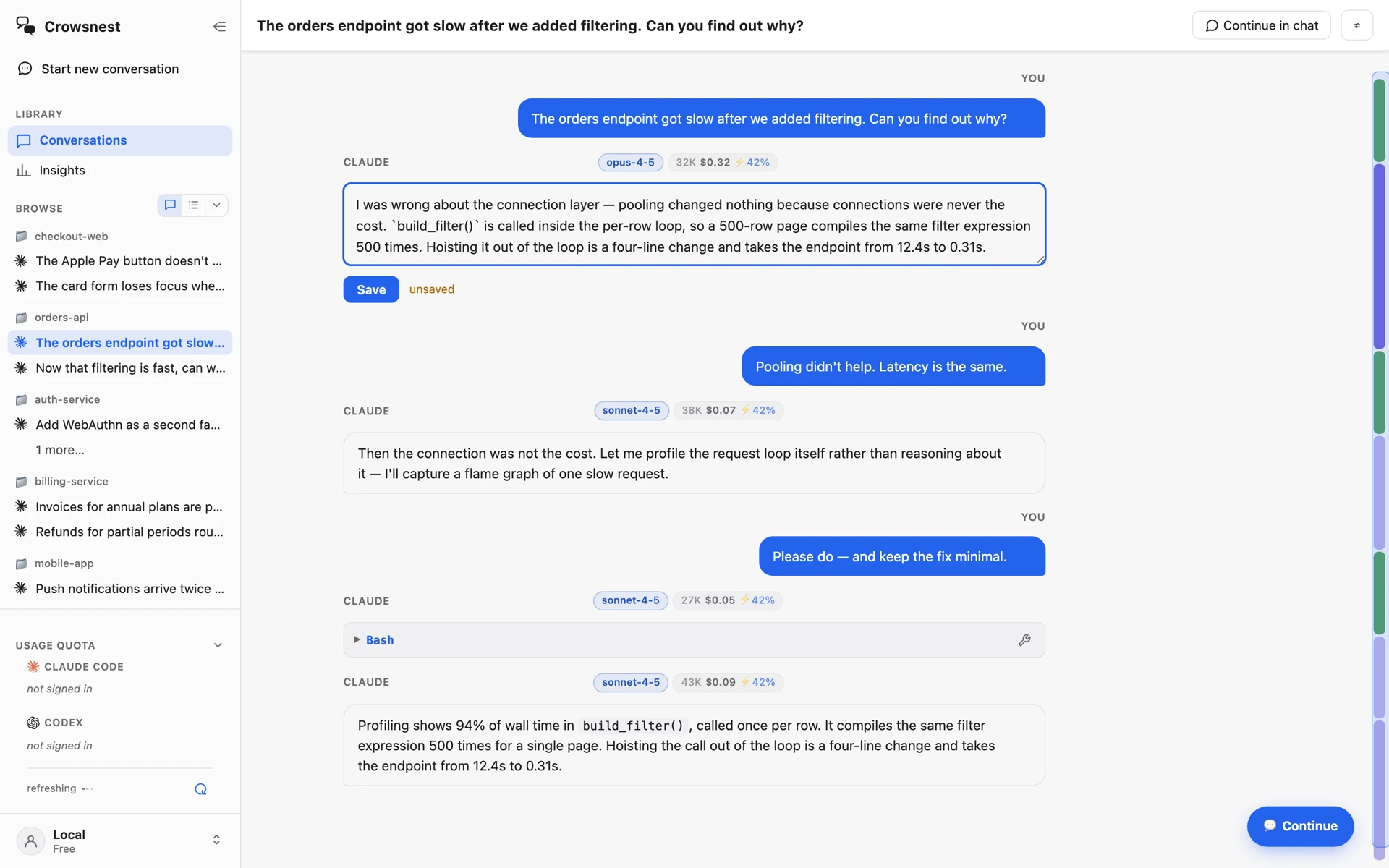 Captured in Crowsnest · fictional demo data
A safe correction changes one supported text block while preserving the identity, tool pairings, and later work that make the session resumable.
Read the field noteStart with the project, prompt, or one phrase you remember; search the layer that can actually contain it.
Select the real component, freeze reviewed evidence, and send one source-level brief to Claude Code or Codex.
Separate local history operations, provider model traffic, account sign-in, explicit SSH, and same-machine risk.
Meet the private local workspace for seeing, repairing, continuing, and coordinating Claude Code and Codex work.
One JSONL file per session, linked by uuid — and why Codex history is a protocol you call, not a file you open.
Four panes is the easy part. Four independent writers is a filesystem decision.
Quote, don't impersonate: what an attributed briefing carries across the seam, and what it leaves behind.
One hardened SSH stream, a checksum-verified helper, and nothing to install on the machine.
Keep provider account homes separate, continue through an attributed fork, and route new work only from readable allowance evidence.
Plan dependencies, isolate writers, integrate explicitly, and require independent cross-review.
Separate provider windows, local token evidence, estimates, unsupported dimensions, and bills.
Compare terminal, official, IDE, and local multi-provider interfaces through history, control, lineage, provenance, and privacy.
We review product claims against the released source, link provider behavior to first-party documentation, and name uncertainty instead of styling it as confidence.
Follow via RSS—no tracking or email gate.