Claude Code and Codex usage: limits, cost, and provenance
A percentage, token count, dollar estimate, and provider invoice can all be accurate while answering four different questions. A useful dashboard keeps those meanings visible.
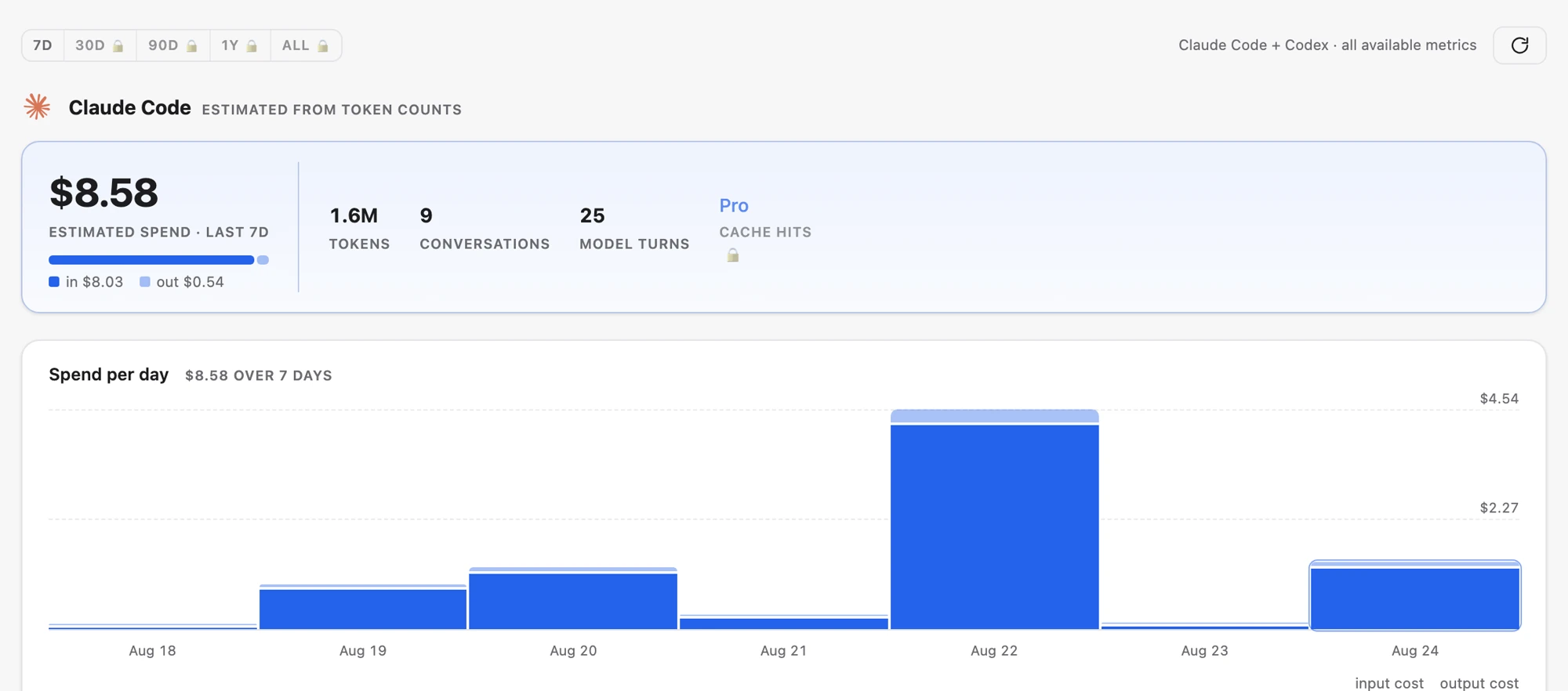
Use the provider window to answer “how close am I to a limit?” Use local transcript evidence to understand recorded work over time. Treat cost as an estimate unless the provider identifies it as reported billing data, and never replace missing attribution with a zero.
“Usage” is at least four different things.
| Number | Question it answers | What it cannot prove |
|---|---|---|
| Provider window | How much of a current session or weekly allowance has been consumed, and when it resets. | Exact historical cost per project or conversation. |
| Local token evidence | What recorded conversations report across a selected local date range. | Activity missing from local history or dimensions the provider did not store. |
| API-equivalent estimate | What observed tokens might cost under stated API pricing assumptions. | Subscription value, discounts, surcharges, or the provider's final charge. |
| Billing record | What the provider actually charged or invoiced. | Why usage occurred unless the billing system supplies that attribution. |
A trustworthy UI labels these separately. Combining them under one unlabeled “cost” total makes precision look better while making the decision worse.
Claude Code and Codex expose different evidence.
Normalization should make two providers easier to scan, not pretend their telemetry is identical. Crowsnest keeps provider-specific limitations visible.
Claude Code
Local transcript history can support estimates and richer breakdowns where the recorded messages contain enough model, token, project, time, cache, and conversation evidence.
Codex
The account endpoint supplies current account windows, while historical charts stay token-only. It does not honestly attribute daily usage to model, project, conversation, cache, hour, or cost.
For Codex, an API-equivalent range estimate is possible only when complete per-thread token counters exist and the configured model can be priced. That estimate excludes cases its assumptions cannot represent, such as unknown models or missing counters, and reports coverage instead of silently pricing incomplete data.
An unavailable value is not zero. “No evidence” and “no usage” must remain visibly different states.
Follow the label back to its evidence.
- Check the scope.Is this the current provider window, a local 7-day range, or all recorded history?
- Check the source.Was the value read from provider account usage, calculated from local transcripts, or inferred from thread counters?
- Check the assumption.Which model and pricing basis produced a dollar estimate, and which surcharges or plan terms are outside it?
- Check coverage.How many conversations supplied enough counters to be included, and how many remained unpriceable?
- Check missing dimensions.If project or model attribution is unsupported, the interface should omit it rather than manufacture an all-zero chart.
Anthropic's Claude Code cost documentation is the first-party reference for current cost behavior. Treat any local interface—including Crowsnest—as an operational view, not as a replacement for provider billing records.
Current-window awareness for everyone; deeper local Insights in Pro.
Every Crowsnest plan shows the current window's usage and spend where the runtime provides enough evidence. Pro adds local ranges of 7, 30, 90, or 365 days and all recorded history, plus supported breakdowns by day, model, project, hour, cache behavior, and conversation.
Those breakdowns remain capability-aware. A dimension appears only where the provider supplies evidence for it. Claude cost values are local estimates. Codex cost values are conditional API-equivalent estimates with assumptions and coverage. Neither is presented as a billing ledger.
Crowsnest computes these views from local provider history and keeps conversations on the machine. The interface binds to 127.0.0.1; account traffic is limited to sign-in and session refresh and does not include prompts, answers, project paths, or usage analytics.
Sources and related field notes
Provider reference: Anthropic's Claude Code costs documentation. Crowsnest usage and provenance behavior was checked against the released provider adapters, transcript accounting, and Insights boundaries on August 24, 2026.
Published and source-reviewed August 24, 2026. Provider plans, windows, and pricing can change; use first-party account and billing surfaces for current limits and charges.